
Morgan County Parole or Probation?
Parole and probation both allow a person to live in the community under rules, but they arise from different decisions. The Utah Board of Pardons and Parole may grant parole before a prison sentence reaches its maximum expiration. A Morgan court imposes probation as part of sentencing. UDC Adult Probation and Parole, known as AP&P, conducts field supervision for both. The controlling order identifies the authority, conditions, and expected end point.
A jail release type should be read before assigning either label. Bond and recognizance end confinement while a case continues, but they are not probation unless a judge orders it. Time served completes a custody term, yet an existing probation order may remain. A transfer from Weber or Davis to UDC starts another custody stage rather than community supervision. These distinctions keep Morgan release records tied to the right agency.
| Feature | Parole | Probation |
|---|---|---|
| Who orders it | Utah Board of Pardons and Parole | Sentencing court |
| What comes first | A state-prison commitment | A court sentence, sometimes with jail |
| Field supervision | UDC AP&P | UDC AP&P when assigned |
| Main verification | Board decision plus UDC status | Court order plus AP&P confirmation |
| How it ends | Board termination or sentence expiration | Court discharge or sentence completion |
- Absconder
- A supervised person alleged to have stopped reporting or left supervision without permission.
- Warrant
- A legal order authorizing arrest; it is not the same as a final violation finding.
- Discharge
- The end of supervision or sentence authority shown by an official order or record.
Check Morgan Post-Release Supervision
Begin with the system that created the status. For parole, the Board hearing and decision search accepts both first and last name, an offender number, or a date range. Known aliases may appear. A future calendar entry is not proof of release, and a hearing does not itself decide the case. The Board states that decisions usually post after the hearing.
- Match the person by full name, offender number, and any known alias.
- Open the published Board decision, not just the hearing calendar.
- Check UDC Offender Search for status, location, and Release Date/Type.
- For probation, read the Morgan sentencing order and later docket entries.
- Call AP&P or the Board when the records conflict or the assigned office is unclear.
UDC data is not real time. An administrative location can differ from the physical place, and a county detainee who never entered UDC authority may have no UDC result. Use the Morgan County release-record search for a jail-only release and its custodial record.
The official Board search is shown below. Open the actual decision document and compare its offender number and date with the UDC record.
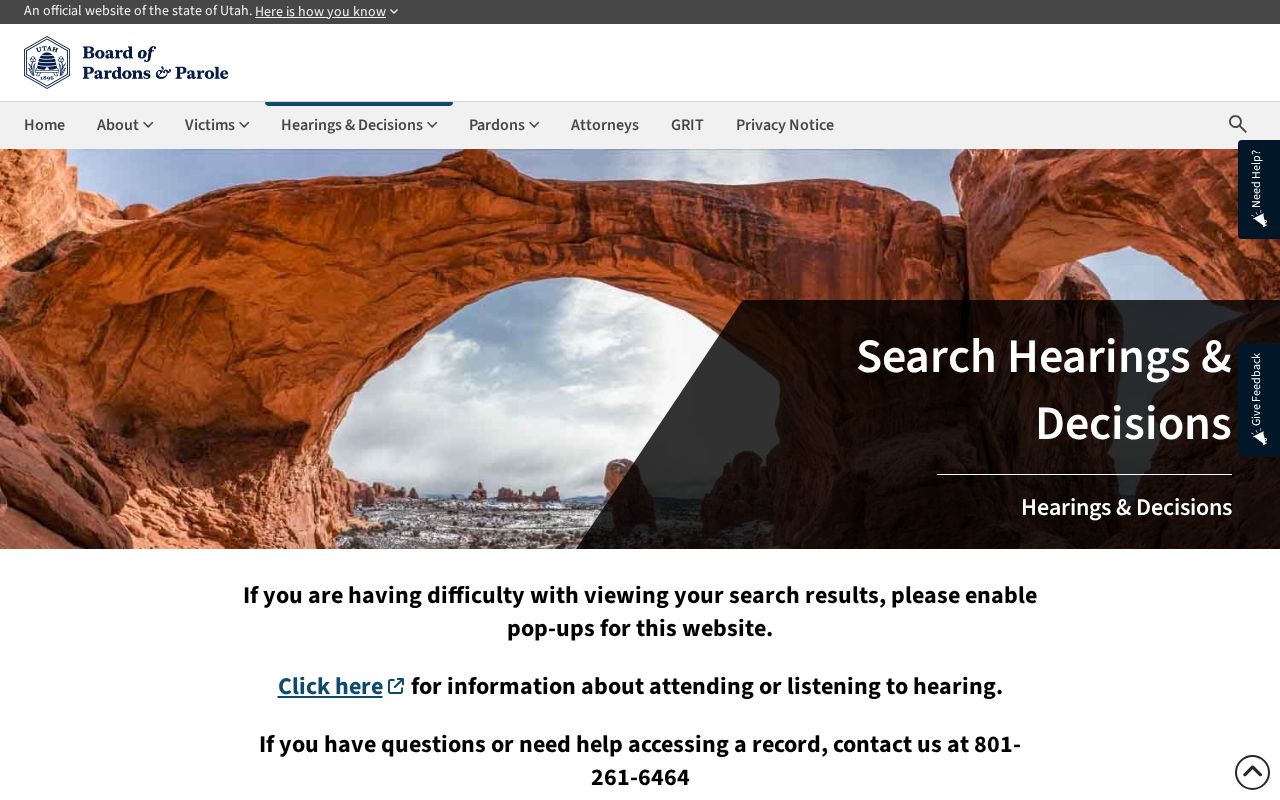
The image shows the proper decision channel; a calendar result by itself does not confirm that Morgan post-release supervision began.
Morgan County AP&P Supervision Office
Research routes Morgan supervision questions through the UDC Adult Probation and Parole system to Region 2 in Ogden. Confirm the assignment before visiting because field supervision follows the case and assigned agent, not a county web page. The office can route a person who knows the supervised individual's name or offender number. It cannot turn a public inquiry into a substitute for the governing order.
UDC Adult Probation and Parole, Ogden
2540 Washington Boulevard, 5th Floor
Ogden, UT 84401
801-626-3700
For Board status, decisions, or parole authority, contact the Utah Board of Pardons and Parole at 801-261-6464 or 448 East Winchester Street, Suite 300, Murray, UT 84107. Court-ordered probation questions may also require the Morgan court file. Second District Court handles adult felonies and Class A misdemeanors, while Morgan Justice Court handles lower matters within its jurisdiction.
The Board and AP&P have separate roles. The Board sets parole dates, addresses alleged parole violations, and can terminate a sentence. AP&P performs field supervision and office routing. Calling the right office reduces conflicting answers. When the question concerns a probation term imposed by a judge, start with the signed court order and use AP&P to confirm the active assignment.
Morgan Supervision Violations and Warrants
Conditions vary by the governing order and case. Common supervision work can include reporting, approved residence or travel, treatment, testing, restitution or fines, community service, and an individual case plan. Only the current order and supervising agency show the actual terms. A suspected violation can lead to investigation, a warrant, a Board parole-violation process, a court hearing, return to custody, reinstatement, or another decision. No single step proves the final outcome.
A person described as an absconder has allegedly stopped complying with reporting or location requirements. Confirm an active warrant through the responsible court or agency. Do not infer it from an old roster or missed VINE alert. For parole matters, the Board may hold an evidentiary or violation hearing and later publish a decision. Search the decision again after the proceeding.
A scheduled violation hearing is not a ruling. Match the later Board or court order with the current UDC custody or supervision status.
VINE may send a custody, transfer, or release notice for a participating record. It does not certify a parole violation, warrant, or discharge. UDC has warned that notifications can be missing or inaccurate, so a VINE event should lead to direct confirmation. The Board decision, court order, and agency status remain the key records.
When Morgan Supervision Ends
A prison release does not necessarily end the sentence. Parole commonly changes secure custody to community supervision while the Board retains authority. Utah Code §77-27-12 concerns parole discharge and sentence termination. A Board termination order, sentence expiration, or another formal action supplies the durable proof. UDC status should then be read with that order because database updates may lag.
Probation ends through the sentencing court's authority. The docket may show successful completion, early termination, expiration, revocation, or another order. Do not call a jail release a probation discharge. A person may leave a short jail stay and still return to probation. Conversely, a case that no longer appears publicly may have been sealed or expunged, which changes public access rather than proving a particular supervision history.
Utah's indeterminate prison framework also makes dates individual. Sentencing ranges, Board orders, earned time, discipline, new cases, and administrative corrections can affect timing. The official termination record controls over an estimate.
Utah Code §64-13-21 provides earned compliance credit for qualifying parole terms. UDC explains that each successful month on a qualifying three-year term can reduce the maximum parole term by 30 days, so a typical 36-month term may end in 18 months without violations. This is a supervision-duration rule. It is not prison good time and does not promise the same result in every case. Revocation can forfeit the credit, so the final discharge record still controls.
An expunged or sealed case requires added care. Public Xchange omits sealed and expunged files, and a missing public entry does not explain whether supervision ended or why access changed. The person or an authorized party can use Utah Courts procedures to obtain the records available to them. Public-facing text should not recreate material that the government record no longer displays.
Morgan Release Reentry in Weber
Weber Reentry Success Services has local importance because Weber holds Morgan prisoners. Its public Community Reentry Fair is held Tuesdays from 1 to 3 p.m., excluding federal holidays, at 2540 Washington Boulevard in the first-floor conference room. Weber also offers a Thursday pre-release fair for residents within seven days of scheduled release.
The Weber-Morgan justice plan says coordinators may support clients for up to 90 days after release. Services can connect people with peer help, treatment or health continuity, identification, transportation, and case management. Participation does not establish parole or probation status. Verify supervision through AP&P, the Board, and the court, then use reentry staff for the services they actually administer.
A Thursday fair is timed for residents nearing a scheduled release, but a scheduled date can still change. The receiving jail or UDC completes the release. AP&P then confirms reporting instructions when supervision follows. Family and support contacts should rely on the official date and assigned agent rather than assuming attendance at a fair guarantees departure.
Morgan Release Property Depends on Jail
Identification, mail, and property instructions depend on whether Weber or Davis held the Morgan prisoner. Weber's reentry program identifies transportation and identification as practical needs. The Davis sheriff guidance gives a different after-departure rule: mail for a released person is held for pickup for 30 days and then destroyed. Property left after transfer is disposed of after 30 days if unclaimed, with keys handled on a separate basis.
First confirm the receiving facility through the Morgan County Sheriff's Office. Then contact that jail about pickup rules. A release from USCF or CUCF follows UDC procedures instead. Mixing those routes can send a person to the wrong office and does not help verify supervision.
For a state-prison parole, UDC usually processes scheduled releases on Tuesdays at the Utah State Correctional Facility release building. That physical release process is distinct from AP&P reporting. A move to a community correctional center also remains part of the corrections path. The UDC Location and Release Date/Type fields help explain which transition occurred.